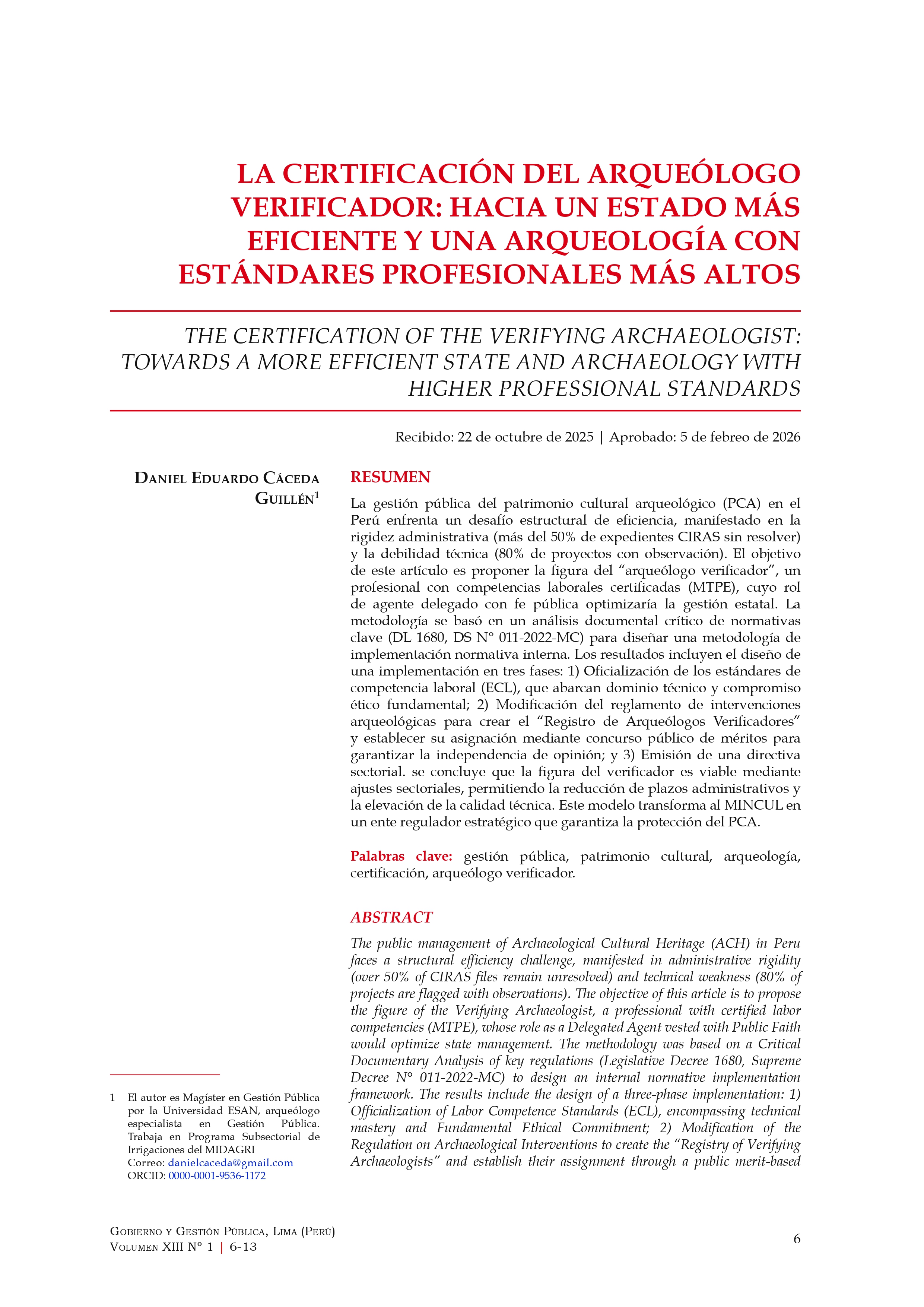
The certification of the verifying archaeologist: towards a more efficient state and archaeology with higher professional standards
DOI:
https://doi.org/10.24265/iggp.2026.v13n1.02Keywords:
public management, cultural heritage, archaeology, certification, verifying arqueologistAbstract
The public management of Archaeological Cultural Heritage (ACH) in Peru faces a structural efficiency challenge, manifested in administrative rigidity (over 50% of CIRAS files remain unresolved) and technical weakness (80% of projects are flagged with observations). The objective of this article is to propose the figure of the Verifying Archaeologist, a professional with certified labor competencies (MTPE), whose role as a Delegated Agent vested with Public Faith would optimize state management. The methodology was based on a Critical Documentary Analysis of key regulations (Legislative Decree 1680, Supreme Decree N° 011-2022-MC) to design an internal normative implementation framework. The results include the design of a three-phase implementation: 1) Officialization of Labor Competence Standards (ECL), encompassing technical mastery and Fundamental Ethical Commitment; 2) Modification of the Regulation on Archaeological Interventions to create the "Registry of Verifying Archaeologists" and establish their assignment through a public merit-based competition to guarantee independence of opinion; and 3) Issuance of a Sectoral Directive. It is concluded that the Verifying Archaeologist figure is viable through sectoral adjustments, allowing for the reduction of administrative turnaround times and the elevation of technical quality. This model transforms the Ministry of Culture (MINCUL) into a strategic regulatory entity that guarantees the protection of ACH.
Downloads
References
Brum Bulanti, L., & Gianotti García, C. (2024). Arqueología preventiva en tiempos de crisis. Una revisión desde una perspectiva sudamericana. Práctica Arqueológica, 7(2), 65-79. https://plarci.org/index.php/practica-arqueologica/article/view/1562
Cáceda Guillén, D. E. (2025, Abril 29). La certificación de arqueólogos: Hacia un estado más eficiente y una arqueología con estándares profesionales más altos [Presentación en foro]. I Foro de Arqueología Peruana: Estrategia, Desarrollo y Futuro, Perú.
ISO. (2010). Certificación de conformidad modelos de certificación ISO/CASCO. Organización Internacional de Normalización.
Perú. Congreso de la República. (2002). Ley N° 27658: Ley Marco de Modernización de la Gestión del Estado. Recuperado de https://www.oas.org/juridico/spanish/per_res21.pdf
Perú. Congreso de la República. (2024). Decreto Legislativo N° 1680: Decreto Legislativo que establece el Diagnóstico Arqueológico de Superficie. Recuperado de https://leyes.congreso.gob.pe/Documentos/2021_2026/Decretos/Legislativos/2024/DL-1680.pdf
Perú. Ministerio de Cultura. (2022). Decreto Supremo N° 011-2022-MC: Aprueban el Reglamento de Intervenciones Arqueológicas. El Peruano.
Perú. Ministerio de Trabajo y Promoción del Empleo. (2023). Decreto Supremo N.° 004-2023-TR: Estrategia Nacional para promover la certificación de competencias laborales al 2025. Recuperado de https://www.gob.pe/institucion/mtpe/normas-legales/4101306-004-2023-tr
Perú. Presidencia del Consejo de Ministros. (2024). Dictamen Final Favorable del Decreto Legislativo que establece el Diagnóstico Arqueológico de Superficie. Recuperado de https://www.gob.pe/institucion/pcm/informes-publicaciones/6153001-dictamen-final-favorable-del-decreto-legislativo-que-establece-el-diagnostico-arqueologico-de-superficie
SINEACE. (2020). Evaluación de impacto de la certificación de competencias en ocupaciones productivas y servicios. Sistema Nacional de Evaluación, Acreditación y Certificación de la Calidad Educativa. Recuperado de https://guia.oitcinterfor.org/node/230
Downloads
Published
Issue
Section
License
Copyright (c) 2026 Daniel Eduardo Cáceda Guillén

This work is licensed under a Creative Commons Attribution-NonCommercial-ShareAlike 4.0 International License.