The property formalization procedure and binding precedents of the COFOPRI Administrative Property Court
DOI:
https://doi.org/10.24265/iggp.2026.v13n1.03Keywords:
housing informality, general administrative procedure, special formalization procedure, Property Administrative Tribunal, mandatory observance precedentAbstract
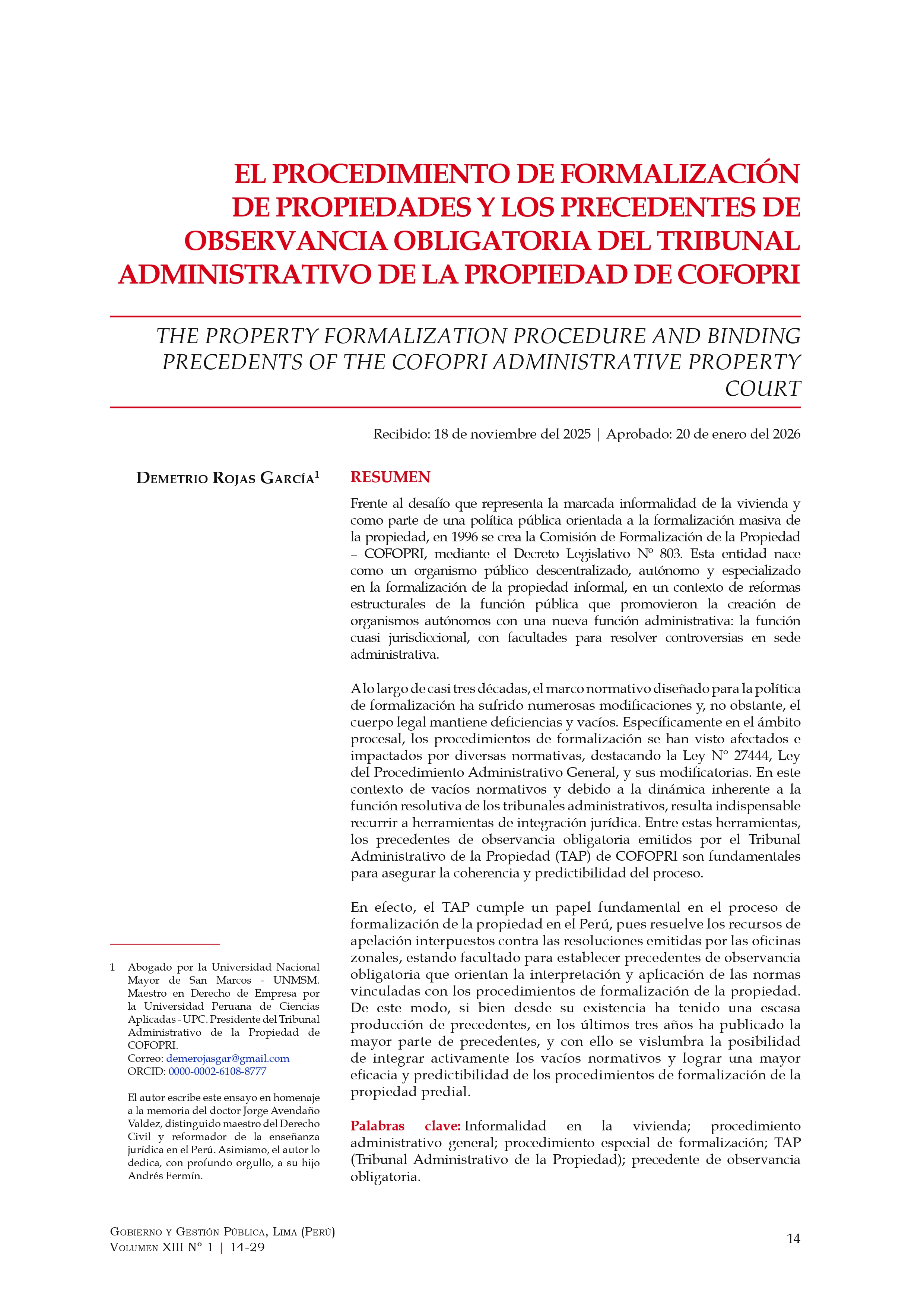
Faced with the challenge posed by widespread informality in housing and as part of a public policy aimed at the mass formalization of property ownership, the Commission for the Formalization of Property – COFOPRI – was created in 1996 through Legislative Decree No. 803. This entity was established as a decentralized, autonomous public body specializing in the formalization of informal property ownership, within a context of structural reforms to the public sector that promoted the creation of autonomous agencies with a new administrative function: a quasi-jurisdictional function, with the power to resolve disputes administratively.
Over nearly three decades, the regulatory framework designed for the formalization policy has undergone numerous modifications; however, the legal framework still contains deficiencies and gaps. Specifically in the procedural sphere, formalization procedures have been affected and impacted by various regulations, notably Law No. 27444, the General Administrative Procedure Law, and its amendments. In this context of regulatory gaps and due to the inherent dynamics of the administrative tribunals' decision-making function, it is essential to resort to legal integration tools. Among these tools, the binding precedents issued by the Administrative Property Tribunal (TAP) of COFOPRI are fundamental to ensuring the coherence and predictability of the process.
Indeed, the TAP plays a fundamental role in the property formalization process in Peru, as it resolves appeals filed against resolutions issued by the Zonal Offices. It is empowered to establish binding precedents that guide the interpretation and application of the regulations related to property formalization procedures. Thus, although it has produced few precedents since its inception, it has published the majority of them in the last three years, thereby offering the possibility of actively filling regulatory gaps and achieving greater efficiency and predictability in property formalization procedures.
Downloads
References
Agustín Gordillo (2003). Tratado de Derecho Administrativo. Tomo 2. ARA Editores.
Avendaño Valdez, Jorge (1990). Materiales de enseñanza para el estudio de Libro V del Código Civil en la Facultad de derecho. Segunda Edición. Pontificia Universidad Católica del Perú.
Cabanellas Guillermo (2001). Diccionario Enciclopédico de Derecho Usual. Tomo I. 27ª Edición. Editorial Heliasta. Buenos Aires.
COFOPRI. Memoria Anual 2024 (2024). Recuperado de: https://enlaces.cofopri.gob.pe/media/10771/memoria_anual_2024.pdf
Congreso Constituyente Democrático. (1993). Constitución Política del Perú de 1993. Diario Oficial El Peruano del 29 de diciembre de 1993. https://www.linguee.es/espanol-ingles/traduccion/si+corresponde.html
De Soto, H., Ghersi, E., & Ghibellini, M. (1986). El otro sendero: La revolución informal. Editorial El Barranco.
Decreto Supremo N° 004-2019-JUS. Texto Único Ordenado de la Ley N° 27444, Ley del Procedimiento Administrativo General. (2019). Diario Oficial El Peruano.
Diario Oficial El Peruano. Precedentes vinculantes. Recuperado de: https://diariooficial.elperuano.pe/Jurisprudencia
Dromi Roberto (2004). Derecho Administrativo – Parte Primera. 10ª Edición Actualizada. Buenos Aires – Madrid.
Morón Urbina (2017). Comentarios a la Ley del Procedimiento Administrativo General. Octava Edición – Lima.
Presidencia de la República del Perú. (1984). Decreto Legislativo 295 de 1984. Código Civil. Diario Oficial El Peruano del 25 de julio de 1984.
Rojas G. Demetrio (2018). Derecho Administrativo General. Prometheo. El Procedimiento Administrativo y la actividad de Fiscalización. Recuperado de: https://prometheo.pe/el-procedimiento-administrativo-y-la-actividad-de-fiscalizacion/
Downloads
Published
Issue
Section
License
Copyright (c) 2026 Demetrio Rojas García

This work is licensed under a Creative Commons Attribution-NonCommercial-ShareAlike 4.0 International License.