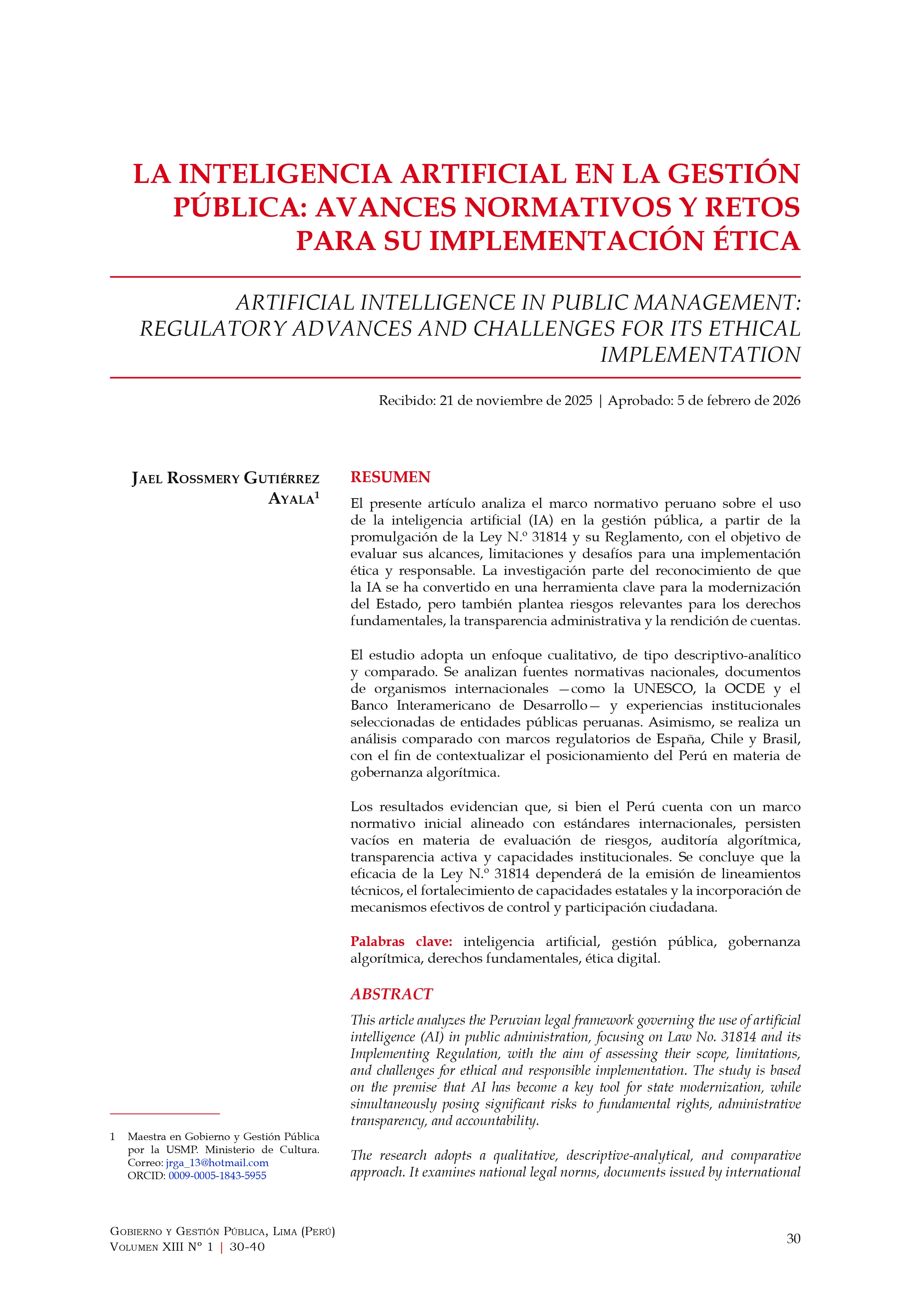
Artificial intelligence in public management: regulatory advances and challenges for its ethical implementation
DOI:
https://doi.org/10.24265/iggp.2026.v13n1.04Keywords:
artificial intelligence, public administration, algorithmic governance, fundamental rights, digital ethicsAbstract
This article analyzes the Peruvian legal framework governing the use of artificial intelligence (AI) in public administration, focusing on Law No. 31814 and its Implementing Regulation, with the aim of assessing their scope, limitations, and challenges for ethical and responsible implementation. The study is based on the premise that AI has become a key tool for state modernization, while simultaneously posing significant risks to fundamental rights, administrative transparency, and accountability.
The research adopts a qualitative, descriptive-analytical, and comparative approach. It examines national legal norms, documents issued by international organizations—such as UNESCO, the OECD, and the Inter-American Development Bank—and selected institutional experiences within Peruvian public entities. In addition, a comparative analysis with regulatory frameworks from Spain, Chile, and Brazil is conducted to contextualize Peru’s position in the field of algorithmic governance.
The findings indicate that although Peru has established an initial regulatory framework aligned with international standards, significant gaps remain in risk assessment, algorithmic auditing, active transparency, and institutional capacity. The article concludes that the effectiveness of Law No. 31814 will largely depend on the adoption of technical guidelines, the strengthening of public sector capacities, and the implementation of effective mechanisms for oversight and citizen participation.
Downloads
References
Banco Interamericano de Desarrollo (BID). (2022). La inteligencia artificial en el sector público de América Latina. Washington D.C., pp. 18-25.
Banco Interamericano de Desarrollo. (2020). Gobernanza de la Inteligencia Artificial: Marco conceptual y recomendaciones para América Latina. BID.
Bannister, F., & Connolly, R. (2020). The future ain’t what it used to be: Artificial intelligence and the public sector. Government Information Quarterly, 37(3).
CAF – Banco de Desarrollo de América Latina. (2022). Transformación digital y uso responsable de IA en el sector público. CAF.
CEPAL. (2022). Inteligencia artificial y automatización en América Latina: riesgos, oportunidades y gobernanza. CEPAL.
Congreso Nacional do Brasil. (2023). Projeto de Lei sobre Inteligência Artificial. Brasília, s.p.
Consejo de Europa. (2022). Guidelines on the responsible use of artificial intelligence in the public sector. Council of Europe.
Crawford, K. (2021). Atlas of AI. Yale University Press.
Daniels, J. (2020). The Algorithmic Society: Technology, Power, and Knowledge. New York University Press.
Eubanks, V. (2018). Automating Inequality: How High-Tech Tools Profile, Police, and Punish the Poor. St. Martin’s Press.
European Union. (2024). Recital 102 – Artificial Intelligence Act. https://artificialintelligenceact.eu/article/102/
European Union. (2024). Regulation (EU) 2024/1689 – Artificial Intelligence Act. https://artificialintelligenceact.eu/es/
Floridi, L. & Cowls, J. (2019). A Unified Framework of Five Principles for AI in Society. University of Bologna. Italy.
Floridi, L. (2022). The Ethics of Artificial Intelligence. Oxford University Press.
Gobierno del Perú. (2020). Decreto Legislativo N.º 1412. Ley de Gobierno Digital. Diario Oficial El Peruano.
Gobierno del Perú. (2021). Decreto Supremo N.º 029-2021-PCM. Reglamento de la Ley de Gobierno Digital. PCM.
Microsoft – IDC. (2023). The Future of AI in Latin America.
Ministerio de Ciencia, Tecnología, Conocimiento e Innovación. (2021). Estrategia Nacional de Inteligencia Artificial. Gobierno de Chile, pp. 45-52.
O’Neil, C. (2016). Weapons of Math Destruction: How Big Data Increases Inequality and Threatens Democracy. Crown.
OCDE. (2021). Artificial Intelligence in the Public Sector: Overview of Use Cases and Trends. OECD.
OECD. (2019). OECD Principles on Artificial Intelligence. OECD. https://oecd.ai
ONU. (2021). Roadmap for Digital Cooperation. United Nations.
Pasquale, F. (2020). New Laws of Robotics. Harvard University Press.
Perú. Congreso de la República. (2023). Ley N.º 31814. Ley que promueve el desarrollo de la inteligencia artificial en el país. Diario Oficial El Peruano.
Presidencia del Consejo de Ministros. (2021). Política Nacional de Transformación Digital al 2030. PCM.
Secretaría de Gobierno y Transformación Digital. (2022). Agenda Digital al 2030. PCM.
Undurraga, T., & Velasco, M. (2022). Gobernanza algorítmica en el sector público: desafíos éticos y regulatorios. Revista de Gestión Pública, 9(2), 45–67.
UNESCO. (2022). Recomendación sobre la ética de la inteligencia artificial. Adoptada el 23 de noviembre de 2021. UNESCO. https://unesdoc.unesco.org/ark:/48223/pf0000381137_spa
Veale, M., & Edwards, L. (2018). Clarity, transparency and accountability in algorithmic decision-making. Big Data & Society.
Zuboff, S. (2019). The Age of Surveillance Capitalism. PublicAffairs.
Downloads
Published
Issue
Section
License
Copyright (c) 2026 Jael Rossmery Gutiérrez Ayala

This work is licensed under a Creative Commons Attribution-NonCommercial-ShareAlike 4.0 International License.